
Why Your Business Needs Technical SEO
You have heard that SEO matters. Maybe you have already invested in content, paid for a blog post or two, or spent time making sure your website mentions the right keywords. That is a reasonable place to start.
But if the technical foundations of your website are not right, none of that work is performing at the level it should. This is the part of SEO that most small businesses either overlook or underestimate. It is also, in many cases, the part that is holding their rankings back the most.
This post explains what technical SEO actually is, why it matters for small businesses and what a real-world improvement looks like.

Lee Watts
, Technical Director
November 12, 2026
What Is Technical SEO?
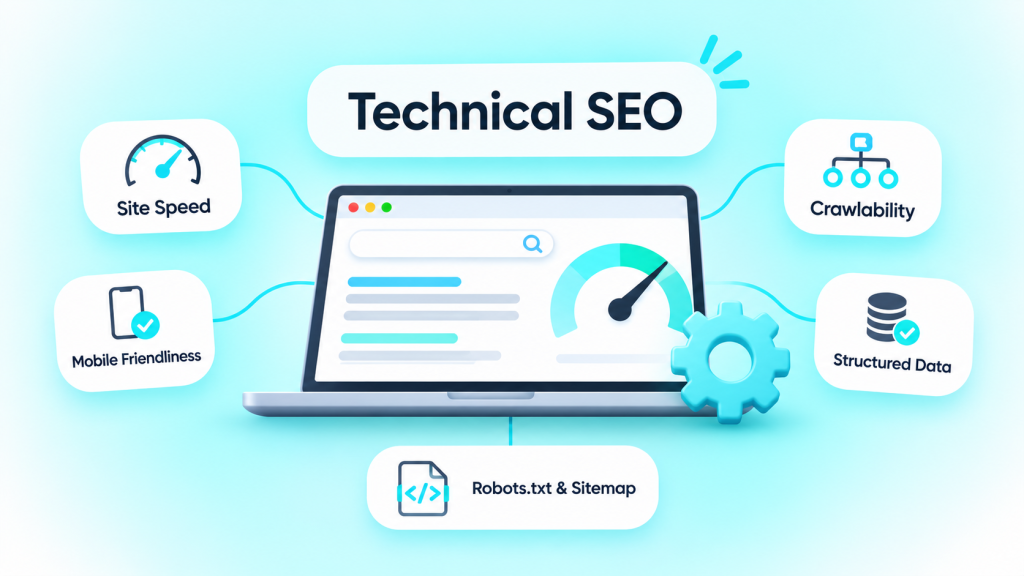
Technical SEO refers to the behind-the-scenes elements of your website that affect how search engines find, read and rank your pages. It has nothing to do with the words on your pages or who links to you. It is about the structure, speed and health of the website itself.
That includes things like:
- How fast your pages load — Google uses page speed as a ranking factor, and slow sites lose both rankings and visitors
- Whether Google can crawl your site properly — if search engines cannot access your pages, they cannot rank them
- How your site is structured — URL structure, internal linking and site architecture all affect how search engines understand what your site is about
- Whether your site works on mobile — the majority of searches happen on mobile devices and Google indexes the mobile version of your site first
- Core Web Vitals — Google’s specific performance metrics that measure how fast and stable your site feels to a real user
- Structured data — code that tells search engines exactly what your content is, which also feeds into how AI platforms like Google AI Overviews cite your business
None of this is visible to your visitors in the same way a blog post or a service page is. That is partly why it gets neglected. But its impact on your rankings is very real.
Why Small Businesses Often Have Technical SEO Problems
Technical SEO issues tend to build up quietly. They are rarely the result of one catastrophic decision. More often, they accumulate over time: a website that was built quickly without SEO in mind, a CMS that generates duplicate pages by default, a redirect chain that grew a little longer with every site update, images that were never compressed.
For small businesses, there are a few patterns we see repeatedly.
The site was built by a designer, not an SEO
This is not a criticism. A designer’s job is to make something look good and work well for users. Unless SEO is explicitly part of the brief, the technical elements that matter to search engines often do not get considered. The result is a site that looks professional but is structurally invisible to Google.
The site was built on cheap shared hosting
Hosting affects load speed, and load speed affects rankings. A site hosted on a low-cost shared server is competing with hundreds of other sites for the same resources. The result is slower response times and a site that consistently fails Google’s performance benchmarks.
Nobody has ever audited it
Most small business websites have never had a proper technical SEO audit. Issues that could have been caught and fixed years ago have been quietly suppressing rankings the whole time.
What a Technical SEO Audit Actually Involves
A technical SEO audit is a systematic review of everything that affects how search engines interact with your site. At a minimum, it covers:
Crawlability and indexation
Can Google find all your important pages? Are any pages blocked from being crawled that should not be? Are pages that should be hidden (such as thank-you pages or admin areas) being indexed?
Site speed and Core Web Vitals
How fast does the site load, and does it meet Google’s performance thresholds? This includes server response times, image optimisation, caching and render-blocking scripts.
Mobile performance
Does the site work well on mobile devices? Given that Google uses the mobile version of your site to determine rankings, this is not optional.
URL structure and duplicate content
Are there multiple versions of the same page that could be confusing search engines? Are URLs clean and logical?
Redirect chains
Every time a URL redirects through multiple steps before reaching its destination, it loses a small amount of authority. Chains that have grown over years of site changes can represent a meaningful drag on performance.
Structured data
Is schema markup implemented correctly? This affects how your content appears in search results and how AI platforms understand and cite your business.
Internal linking
Are your pages linking to each other in a way that helps search engines understand your site’s structure and distributes authority to the pages that matter most?
The output of a good audit is not just a list of problems. It is a prioritised action plan: here is what is wrong, here is how significant it is and here is what fixing it is likely to achieve.
A Real Example: Kee Property
Kee Property is a Glasgow-based estate agent and a sister company of ours here at Kee Digital Media, which gives us the ability to work closely on their digital strategy and share results openly.
When we took on their SEO, the site had the kind of technical and content gaps that are common for businesses in competitive local markets. There were no individual location pages to capture searches from across the areas they operate in, and the technical foundations needed work.
We focused on two things: fixing the technical SEO and building out a content strategy around individual location service pages for each area Kee Property covers.
The results were significant. In November 2025, the site was receiving around 174 clicks per month from Google. By September 2026, that had grown to 1,160 clicks in a single month. Impressions over the same period went from under 5,000 per month to over 77,000. Average position moved from around position 24 to position 7.
That is not a small improvement. It is the kind of step change that happens when you fix the foundations and give Google something worth ranking.
What Happens If You Ignore Technical SEO
The honest answer is that your SEO ceiling is lower than it should be.
You might still rank for some things, particularly brand searches or very low-competition terms. But for the keywords that actually drive business, the ones where you are competing against other sites that have done the technical work, you will consistently underperform.
Google has limited time to crawl every site on the internet. If your site makes that job harder, it prioritises other sites. If your pages are slow, visitors leave before they convert and Google takes note. If your content is duplicated across multiple URLs, Google has to guess which version to rank and often guesses wrong.
Technical SEO is not a guarantee of rankings. No single element of SEO is. But it is the foundation that everything else depends on. Content without it underperforms. Links without it underperform.
Where to Start
If you have never had a technical SEO audit, that is the starting point. Before you invest more in content, more in links or more in any other aspect of your digital marketing, it is worth knowing whether your foundations are solid.
A good audit tells you exactly what is there, how serious it is and what fixing it is likely to achieve. It is not an expensive exercise and it gives you something specific to act on rather than continuing to invest in a site that may be working against you.
Is Your Website Holding Back Your Rankings?
Technical issues are one of the most common reasons good content fails to rank. We will audit your site and tell you exactly what is there and what it would take to fix it.